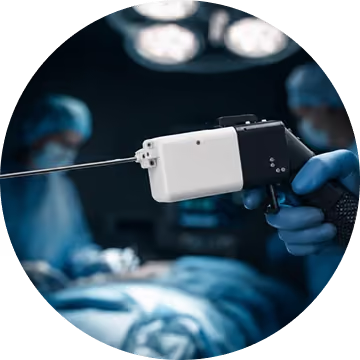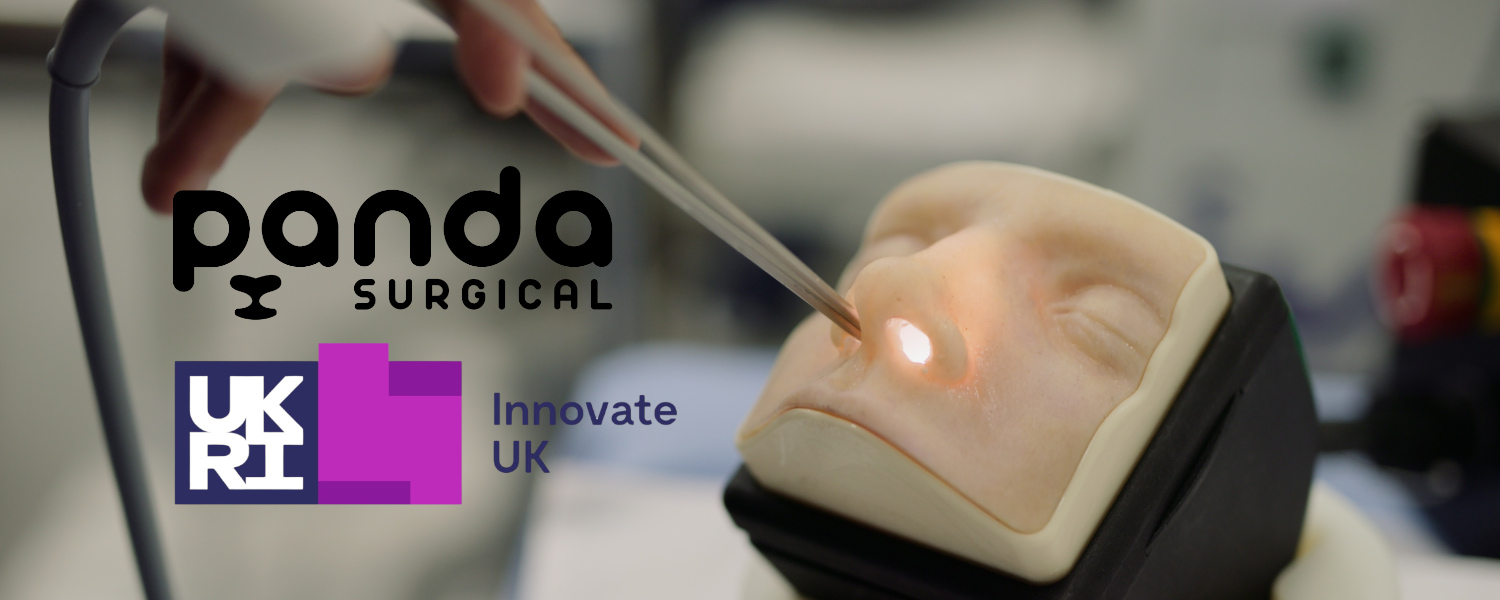
London, UK — September 10th, 2026 – Panda Surgical, developer of handheld robots for minimally invasive neurosurgery, today announced it has been awarded £377,967 by Innovate UK as part of the Biomedical Catalyst. This funding supports an 18-month collaboration with University College London Hospitals (UCLH) to develop a first-of-its-kind “co-pilot” designed to help neurosurgeons navigate and maintain orientation during robotic procedures.
The project addresses one of the persistent challenges in surgery: maintaining orientation. Throughout a procedure, surgeons must constantly localise themselves in relation to critical anatomy to operate safely and precisely. Existing navigation workflows place much of that burden on the surgeon, increasing their mental workload. This cognitive load can make it harder to maintain continuous awareness of the surgical field, increasing the risk of overlooking important details or missing subtle changes during a procedure. Panda Surgical's AI co-pilot aims to provide navigational support, freeing the surgeon to concentrate on their surgical tasks. Because the co-pilot is built around common navigation workflows, it complements the Panda Surgical's existing robotic platform across a wide range of procedures.
“Neurosurgeons have limited room to see, and even less room to operate” said Manios Dimitrakakis, CEO of Panda Surgical. “We’ve solved the confined space issue of minimally invasive brain surgery by giving surgeons greater dexterity. This AI program will close the remaining gap by providing neurosurgeons with advanced vision. We are very grateful to InnovateUK for giving us the resources to progress this cutting-edge solution.”
The AI foundations build on the company’s NIHR-funded work on AI surgical vision, while the underlying robotic system has already been through extensive pre-clinical testing and is now progressing towards first-in-human clinical evaluation. Through this InnovateUK project, the underlying AI work will progress from bench-top prototype to high-fidelity simulation and cadaveric studies in endoscopic neurosurgery. The clinical programme will be led by UCLH at the National Hospital for Neurology and Neurosurgery at Queen Square.
“Navigation and orientation are managed constantly by neurosurgeons, and the cognitive load can be substantial,” said Prof. Hani Marcus, Consultant Neurosurgeon at UCLH and Chief Medical Officer of Panda Surgical. “A smart navigation tool is the kind of support that could make these operations safer.”
The real measure of success will be felt beyond the operating theatre. Safer, less invasive brain surgery has the potential for faster recovery and an earlier return to normal life. By making advanced techniques easier and safer to perform, the technology aims to bring these benefits to more patients beyond a small number of specialist centres.
About Panda Surgical
Panda Surgical, a University College London spinout, is developing the world’s first dexterous robot for minimally invasive neurosurgery, offering surgeons enhanced dexterity and decision-support making these complex operations safer, more effective, and more widely adopted.
For further information, please contact: contact@panda-surgical.com
About Innovate UK
Innovate UK is the UK's innovation agency. We back deep tech businesses in the UK's priority sectors for national benefit, supporting their journey from startup to scaling business to industry leader. We provide the funding, expert support and connections to help breakthrough ideas reach their potential, improve lives and drive economic growth. Innovate UK is part of UK Research and Innovation

We welcome conversations with clinicians, hospitals, researchers, patient organisations and partners who share our ambition.